
VK4AGD RMS on HF bands in Queensland, Australia
We changed the callsign of our RMS but not the location. Our RMS callsign is now VK4AGD. Most often it is on the same 40m frequency as VK4DJC's RMS: 7050.5 kHz dial. With 380 kilometres between us, choose whichever station gives you the best access to Winlink email.
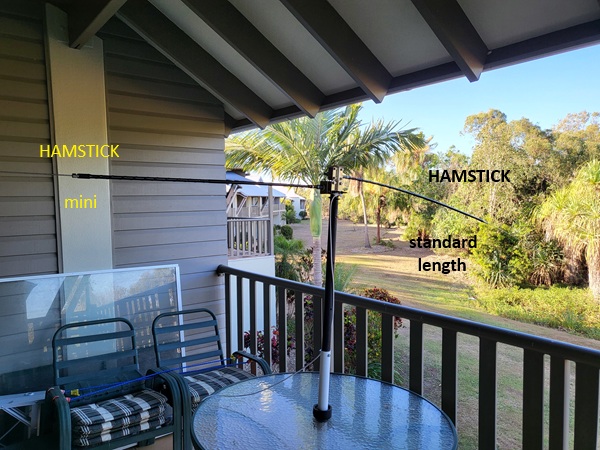
Antenna-wise, we use Shark Hamstick mobile whips because of the limited space on our balcony. We can make a compact horizontal dipole by mounting two whips back-to-back, fed directly with 50-ohm coax cable (no balun). Sandwiched between a sloping steel roof and balcony railing, the setup works remarkably well. The NNW/SSE radiation pattern favours the radioamateur population along the east coast of northern Australia. It also reaches stations in Mount Isa and New Zealand (3000 km away). When contacting stations in Australia's southern states, we can pivot the dipole 20 degrees horizontally to favour their direction.
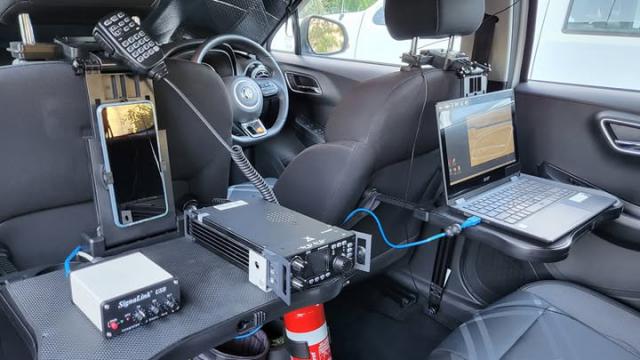
Sometimes we use a shorter Shark mini whip for one half of the dipole (pictured). The mini version is physically easier on our balcony amongst the outdoor furniture and sliding doors. There might be about an S-point difference between the standard and mini versions. Having several mobile whips on 40 metres gives the capability for Winlink HF portable (pictured).
To check propagation with your station, we can mount a whip on top of a 4.5m telescopic vertical pole to provide an omnidirectional Winlink signal on the 80, 40, 30, 20, 12 or 10 metre bands. Please contact us to arrange.
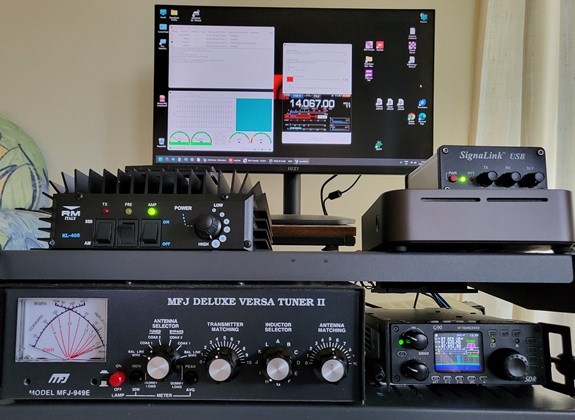
Our RMS comprises a Xiegu G90 transceiver underdriving an RM Italy KL-405V linear amp outputting approximately 100 watts. The linear's integral fan runs continuously to keep it cool, important during long Winlink QSOs.
· Due to QRM from overseas particularly on 40 metres, the receiver preamp is usually off at night and on during daylight hours;
· The AGC is set to Fast to recover quickly from static crashes;
· The squelch is off;
· We use VFO-A for voice, and VFO-B for Winlink — the settings for the mode are retained with each VFO, making it easy to flip back and forth between modes.
The audio interface is a SignaLink USB box connected to a 12-volt DreamQuest miniPC running RMS Trimode and VARA HF software on Windows 11.
The RMS settings are:
· Mode = VaraHF only.
· Session Timeout = 45 minutes, although unregistered VARA connections are limited to 30 minutes.
· Maximum Daily Usage = 150 minutes.
· Wide channel bandwidth = 2750 Hz, with 500 Hz connections accepted.
· Maximum message size = 120 kb.
· Morse ID = on.
· Service Codes = PUBLIC. Occasionally we may use EMCOMM, WICEN or VK4WICEN.
· Availability = H24, except when testing, software updates and SSB voice nets*.
Before calling, please check our current HF frequency on
https://winlink.org/RMSChannels?qt-live_winlink_information=1#qt-live_wi...
by selecting "VARA" — refresh the page if it fails to load.
*Parallel voice and Winlink HF nets:
Once a week (on UTC Saturday from 2200Z) our RMS is used for Winlink check-in messages at the same time as the 'VK4 WICEN' SSB voice nets are conducted on HF. Schedules and frequencies are on the VK4 WICEN/EmComms group page at https://groups.io/g/vk4-emcomms .
Hope to see you in the VK4AGD RMS logs.
73 de sysop VK4GED.
- VK4AGD's blog
- Log in to post comments