
Hurricane Lala Destroyed My VHF Gateway Antenna
Hurricane Lala was a real-world reminder that emergency communications resilience is about much more than having backup batteries, radios, and internet. I operate a VHF Winlink gateway from my home in Kaneohe on the windward side of Oahu. As Hurricane Lala passed Hawaii, Kaneohe experienced some of the stronger winds on Oahu, with a peak gust of approximately 66 mph recorded at Marine Corps Base Hawaii Kaneohe Bay.
I had prepared my station for the storm. At home, I have a 300Ah 12-volt battery system capable of providing substantial backup power, along with Starlink as a backup internet connection if our normal service fails. Commercial power at our home was out for approximately 27 hours, and our regular internet service remained down even longer. But power and internet were not ultimately what took my VHF Winlink gateway off the air. It was the antenna.
SUPPORTING THE OAHU EOC
During Hurricane Lala, I was volunteering at the City and County of Honolulu Emergency Operations Center, supporting emergency communications operations. Our amateur radio station at the EOC performed very well, and our volunteers worked extremely well together handling both Winlink digital communications and voice operations during the event. Winlink once again proved to be a valuable way of moving written information during an emergency, while voice radio provided immediate communications when needed.
After approximately a 17-hour volunteer shift at the Oahu EOC, I still wasn't finished. I then headed to Tiki's Grill & Bar in Waikiki, my regular job, where I spent another approximately four hours dealing with storm-related operations and recovery. By the time I finally made it home, I had been going for roughly 21 hours between emergency communications volunteering and work. That was when I discovered what Hurricane Lala had done to my station.
THE DIAMOND X700 WAS DESTROYED
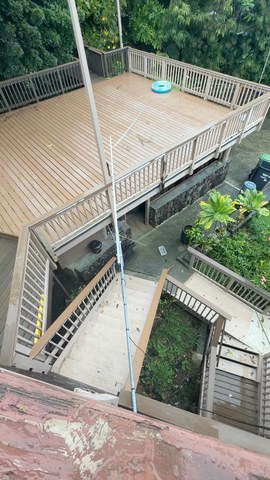
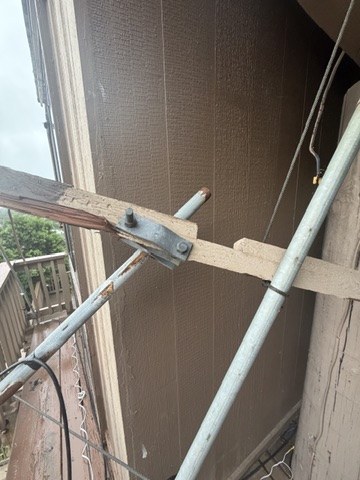
My Diamond X700 VHF/UHF antenna was mounted along the side of the house and was being used by the VHF Winlink gateway. The winds didn't simply bend the antenna. The force on the antenna and mounting system was strong enough to tear the wood away from the side of the house. The antenna came crashing to the ground, smashing and cracking the fiberglass and essentially breaking the antenna in half.
My Diamond X700 was done. So despite having a 300Ah battery bank, Starlink backup internet, and working radio equipment, the gateway wasn't going anywhere. I had power, I had an alternate internet path, and I had the radio. What I didn't have was an antenna.
OFF THE AIR FOR SIX DAYS
The VHF gateway ultimately remained off the air for six days. It wasn't because I couldn't figure out how to get it working again. I simply had too many other priorities immediately following the storm. That may be one of the most important lessons from this event.
In emergency communications planning, we often focus on equipment redundancy: batteries, generators, solar panels, backup internet, spare radios, alternate frequencies, HF, VHF, UHF, and multiple Winlink gateways. All of those things are important, but we sometimes overlook another critical component: the operator.
The person maintaining an emergency communications station may also be the person volunteering at an EOC, supporting RACES operations, helping their community, dealing with damage to their own property, and then going back to their regular job. During a real emergency, repairing your own amateur radio station may not be priority number one. Mine wasn't.
BACK ON THE AIR WITH A ROLL-UP J-POLE
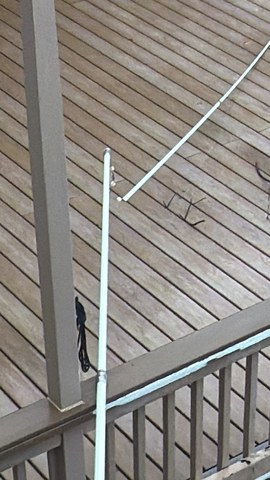
The good news is that my VHF Winlink gateway is currently back on the air. For now, I am using a roll-up J-pole antenna. It's a much simpler antenna than the Diamond X700, but it is working.
Mahalo to everyone who took the time to connect to the gateway and help test it after I brought it back online. Those successful tests confirmed that the VHF gateway is again operational.
There is something fitting about getting an emergency communications gateway back on the air using a simple portable roll-up J-pole. It reinforces another lesson from the storm: the best backup antenna isn't necessarily the biggest or most expensive antenna. It's the antenna you can quickly deploy and get on the air when you need it.
THE BIGGER LESSON
Hurricane Lala reinforced something I believe strongly about emergency communications. We shouldn't build a system that depends on one gateway, one repeater, one antenna, or one operator. If my gateway disappears from the network, another station should be available. If a repeater loses power, operators should know the alternatives. If internet connectivity disappears, we should have alternate paths. If an antenna is destroyed, we should have portable or replacement antennas that can be quickly deployed.
And if one operator is busy working a 17-hour shift at the EOC, other trained operators need to be able to carry the load. That is what a resilient communications network really looks like.
WHAT WORKED
There was also a lot to feel good about after Hurricane Lala. Our amateur radio volunteers at the Oahu EOC performed extremely well. Winlink worked. Voice communications worked. Our volunteers worked together. The systems and training that we had put in place before the storm paid off when they were actually needed.
My home VHF gateway being knocked offline was inconvenient, but emergency communications didn't stop. And that's exactly the point. The goal shouldn't be to build an indestructible station. The goal is to build a resilient network of people and stations where the loss of any single component doesn't take the system down with it.
Hurricane Lala destroyed my Diamond X700 and kept my VHF Winlink gateway off the air for six days. Today, that gateway is back on the air using a roll-up J-pole.
Sometimes resilience is a 300Ah battery bank and Starlink. Sometimes it's a simple piece of wire hanging in the right place.
What matters is getting the message through.
73,
Michael Miller, KH6ML
- KH6ML's blog
- Log in to post comments